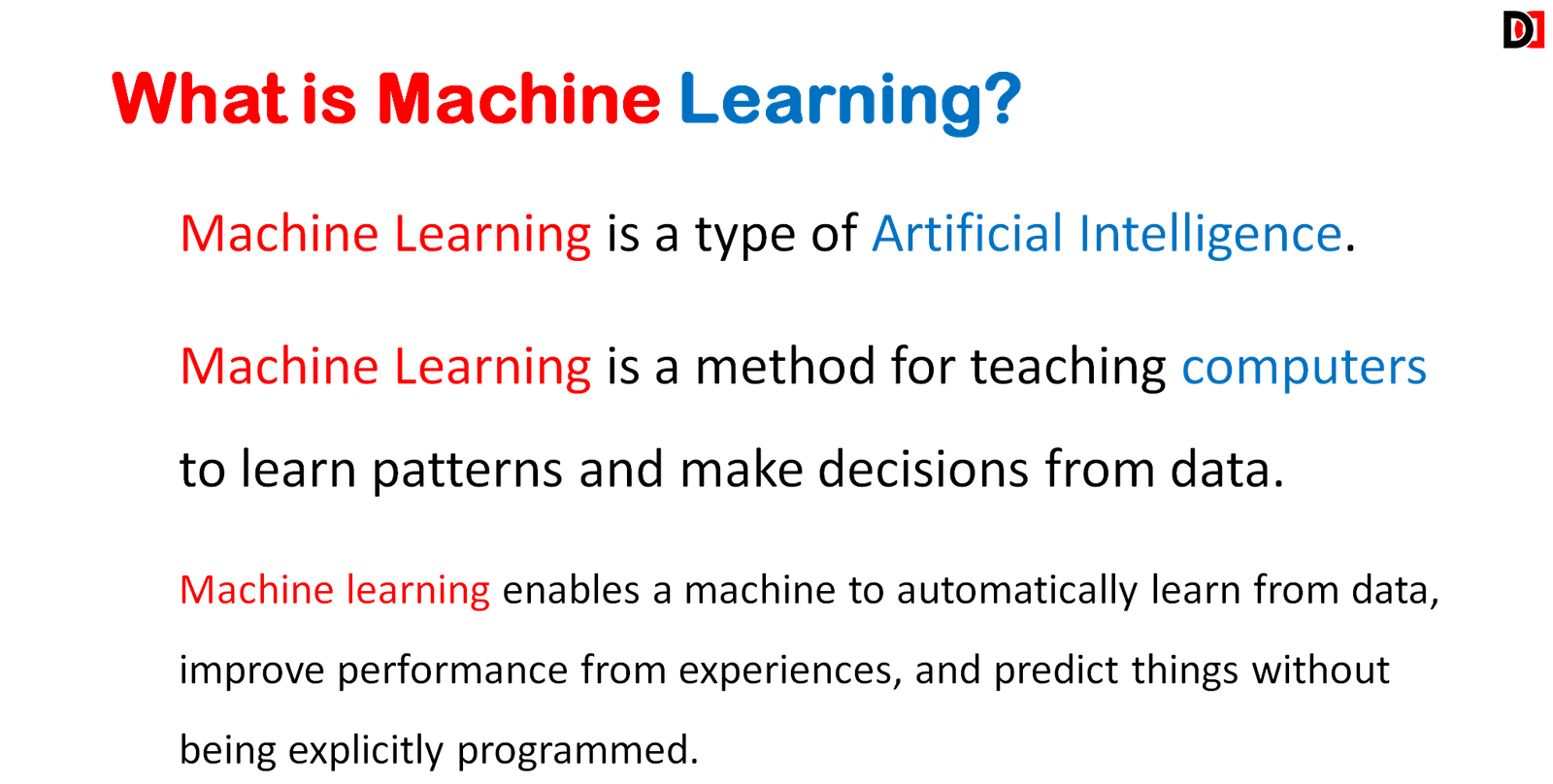
What is Machine Learning?
Machine Learning is a branch of Artificial Intelligence that focuses on creating systems capable of learning and adapting without explicit programming. It leverages algorithms and statistical models to identify patterns in data, enabling machines to make decisions, predictions, or classifications based on inputs. Machine learning empowers systems to continuously improve performance as they process more data over time.
Key aspects of machine learning include:
- Data-Driven Learning: Machines use data to find hidden patterns or relationships.
- Autonomous Decision-Making: It enables predictions and decisions without human intervention.
- Adaptability: Models can adjust to new data and improve over time.
Types of Machine Learning
- Supervised Learning
Supervised learning involves training a model using labeled data, where the input data is paired with the correct output. The model learns to map inputs to the desired outputs and is then tested on unseen data.- Key Features:
- Requires a dataset with labeled examples (e.g., input-output pairs).
- Evaluates model performance using metrics like accuracy or mean squared error.
- Algorithm Categories:
- Classification: Predicts discrete categories (e.g., spam email detection).
- Regression: Predicts continuous values (e.g., house price prediction).
- Key Features:
- Unsupervised Learning
Unsupervised learning involves training a model on unlabeled data. The model identifies underlying structures, patterns, or distributions in the dataset without predefined categories.- Key Features:
- Used for exploratory data analysis.
- Finds hidden insights in large datasets.
- Algorithm Categories:
- Clustering: Groups data into clusters based on similarity (e.g., customer segmentation).
- Dimensionality Reduction: Reduces the number of features in a dataset while retaining essential information (e.g., PCA).
- Key Features:
- Reinforcement Learning
Reinforcement learning focuses on training an agent to make decisions in an interactive environment. The agent learns by receiving feedback in the form of rewards or penalties, aiming to maximize long-term rewards.- Key Features:
- Involves exploration (trying new strategies) and exploitation (using known strategies).
- Models often use Markov Decision Processes (MDPs).
- Key Features:
Applications of Machine Learning
Machine learning drives innovation in numerous fields, solving complex real-world problems. Here are some impactful applications:
- Image Recognition: Facial recognition, medical imaging, and object detection.
- Speech Recognition: Virtual assistants like Siri and Alexa.
- Traffic Prediction: Navigation apps predict traffic patterns and suggest optimal routes.
- Product Recommendations: E-commerce platforms suggest products based on user behavior.
- Self-Driving Cars: Autonomous vehicles make real-time decisions using ML.
- Email Spam Filtering: Identifies and blocks unwanted emails.
- Online Fraud Detection: Detects suspicious transactions in banking and e-commerce.
Best Programming Languages for Machine Learning
Choosing the right programming language can significantly impact your machine-learning projects. Here are some popular languages:
- Python: Widely used for its simplicity and robust ML libraries (e.g., TensorFlow, PyTorch, scikit-learn).
- R: Ideal for statistical analysis and data visualization.
- Java: Preferred for building scalable and production-ready ML systems.
- C and C++: Useful for high-performance applications requiring speed.
- Shell: Effective for data preprocessing and automation tasks.
- Julia: Emerging as a fast and flexible option for numerical computations.