
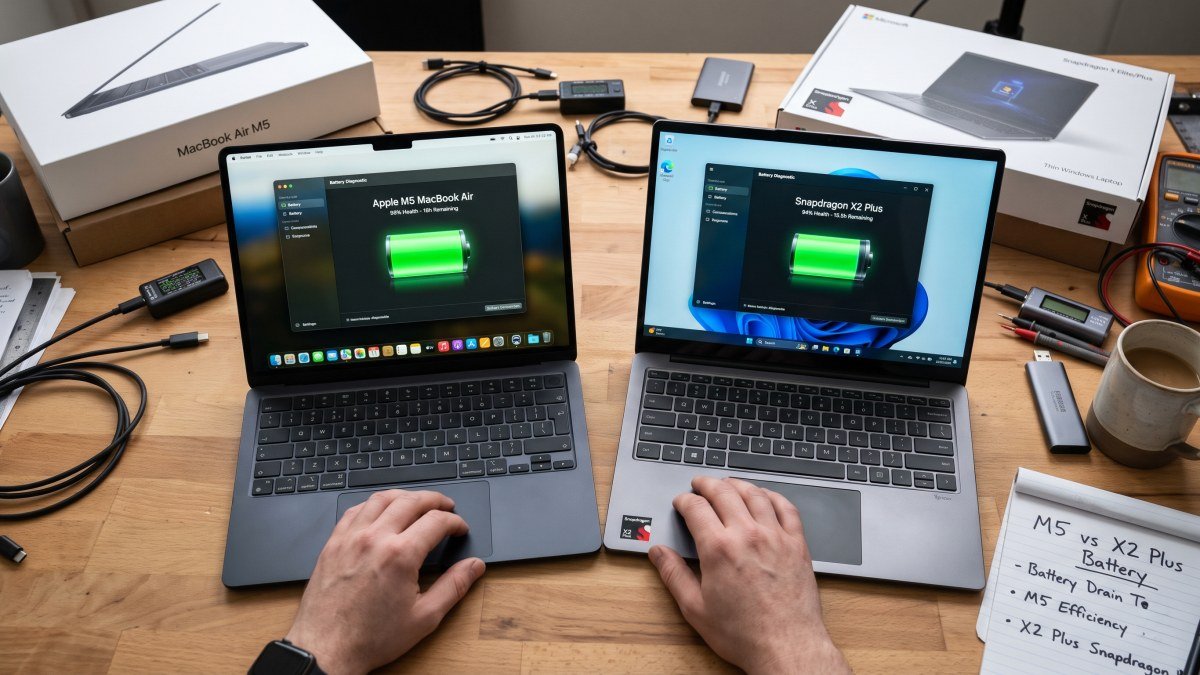
M5 MacBook Air vs Snapdragon X2 Plus: Which 2027 Ultra-Thin Laptop Wins on Battery?
The era of sacrificing battery life for a Windows operating system is officially over. For the past several years, Apple's custom silicon has enjoyed an undisputed monopoly on laptop endurance. However, heading into 2027, the ultra-thin laptop market is facing a massive architectural shakeup. Qualcomm's Snapdragon X2 Plus processor is bringing hyper-efficient ARM computing to Windows machines, directly challenging the upcoming Apple M5 MacBook Air for the all-day battery life crown.
If you are a remote worker, frequent traveler, or student deciding which thin-and-light laptop will actually survive a cross-country flight without a charger, sustained efficiency matters more than raw benchmark scores. Here is a definitive breakdown of how the battery life of the Apple M5 MacBook Air compares to the new wave of Snapdragon X2 Plus Windows laptops.
Apple M5 MacBook Air: The Efficiency Baseline
Apple defined the modern standard for ultra-thin laptop battery life, and the M5 MacBook Air continues that legacy. The upcoming M5 chip relies on a highly refined manufacturing node, paired with a standard 66.5-watt-hour battery inside the 15-inch chassis.
Apple officially claims up to 18 hours of video streaming and 15 hours of wireless web browsing. However, real-world productivity workloads tell a slightly different story. When juggling dozens of Safari tabs, Slack, Zoom calls, and light photo editing, the M5 MacBook Air reliably delivers 14 to 16 hours of continuous screen-on time. This is still phenomenal endurance, allowing you to comfortably leave your charging brick at home for a standard 8-hour workday.
Snapdragon X2 Plus: Windows Finally Catches Up
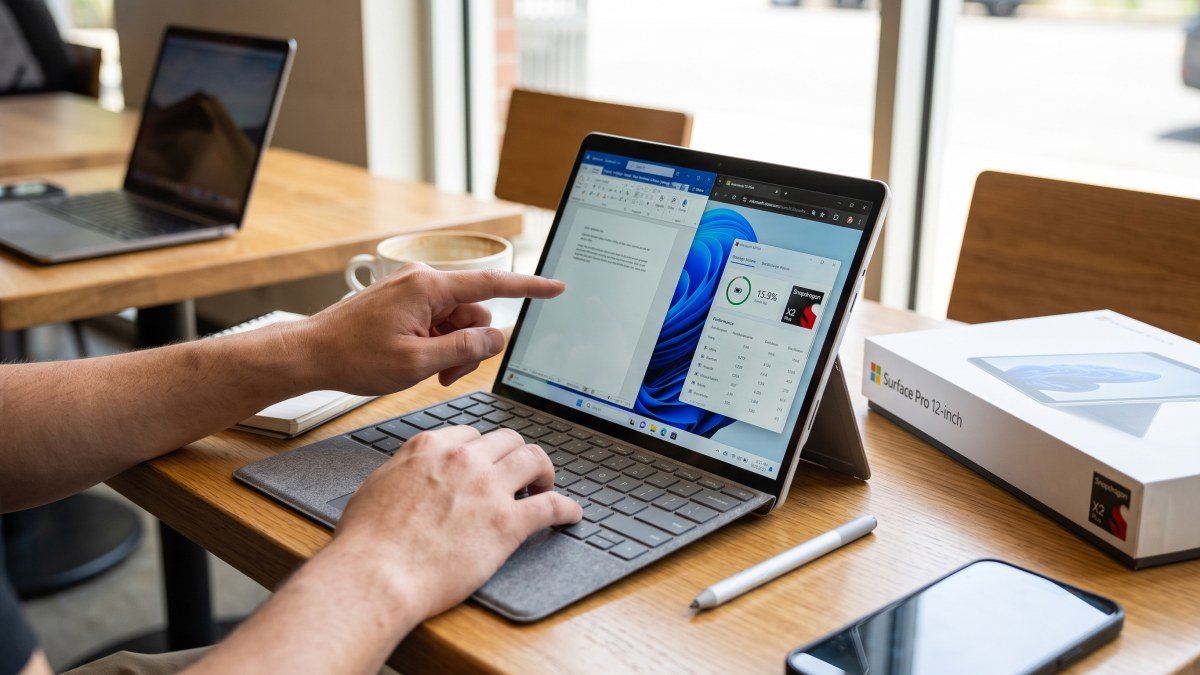
The Snapdragon X2 Plus is Qualcomm's answer to the MacBook Air, specifically engineered for fanless or ultra-quiet thin-and-light Windows laptops. By transitioning to a new 3nm process node, Qualcomm has managed to squeeze unprecedented power efficiency out of its ARM architecture.
Qualcomm heavily advertises that laptops powered by the X-series can achieve up to 22 hours of battery life on a single charge. While OEM implementations vary based on screen brightness and battery size, real-world testing of Snapdragon X2 devices reveals incredible stamina. During continuous video playback, these laptops can push nearly 20 hours. Under mixed productivity workloads, the Snapdragon X2 Plus routinely matches the 14 to 16-hour mark set by the MacBook Air, proving that Windows users no longer have to settle for 6-hour battery lifespans.
Performance on Battery: The Real Test
Historically, Windows laptops suffered from a severe design flaw: to conserve battery, the system would aggressively throttle the processor when unplugged. Your laptop would feel significantly slower at a coffee shop than it did plugged into your desk.
Both the M5 MacBook Air and Snapdragon X2 Plus laptops have completely solved this issue. Because their ARM architectures run so efficiently at low wattages, both processors deliver their full, uncompromised performance whether plugged into a wall outlet or running on battery power. You can export video or compile code at the exact same speed in a park as you would in a studio.
By the Numbers: M5 vs Snapdragon X2 Plus Efficiency
To visualize how these two ultra-efficient ARM processors stack up, here is a comparison of their battery and architectural specifications:
| Specification | Apple M5 MacBook Air | Snapdragon X2 Plus Laptops |
|---|---|---|
| Architecture | Apple Silicon | Qualcomm ARM (3nm) |
| Advertised Battery Life | Up to 18 Hours | Up to 22 Hours |
| Real-World Mixed Use | 14 to 16 Hours | 14 to 16+ Hours |
| Performance Drop on Battery | None (Full Speed) | None (Full Speed) |
| Cooling System | Fanless (Silent) | Fanless / Ultra-Quiet Active |
Swipe sideways to see all table columns →
- Apple M5 MacBook Air
- Apple Silicon
- Snapdragon X2 Plus Laptops
- Qualcomm ARM (3nm)
- Apple M5 MacBook Air
- Up to 18 Hours
- Snapdragon X2 Plus Laptops
- Up to 22 Hours
- Apple M5 MacBook Air
- 14 to 16 Hours
- Snapdragon X2 Plus Laptops
- 14 to 16+ Hours
- Apple M5 MacBook Air
- None (Full Speed)
- Snapdragon X2 Plus Laptops
- None (Full Speed)
- Apple M5 MacBook Air
- Fanless (Silent)
- Snapdragon X2 Plus Laptops
- Fanless / Ultra-Quiet Active
The Verdict: Which Laptop Wins?
Choosing a winner in the battery department is no longer a default victory for Apple. The Apple M5 MacBook Air remains the safest, most consistent choice for long-lasting endurance, backed by a highly optimized macOS environment. However, the Snapdragon X2 Plus has successfully closed the gap for Windows users. If you require Windows-specific software but refuse to compromise on battery life, an ultra-thin laptop powered by the Snapdragon X2 Plus will easily get you through a full workday on a single charge.