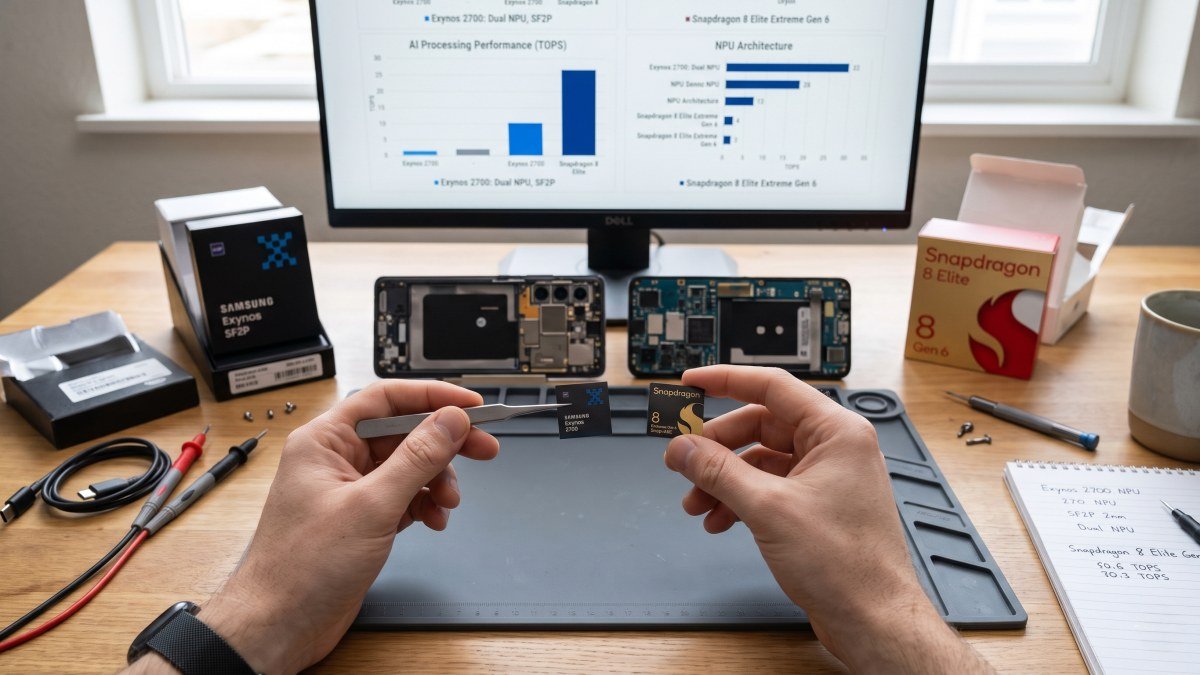
Exynos 2700 vs Snapdragon 8 Elite Extreme Gen 6: Which Chip is Better for On-Device AI?
The smartphone chip war has fundamentally shifted. For the past decade, manufacturers obsessively marketed raw CPU clock speeds and graphical framerates. But in 2027, the ultimate battleground is artificial intelligence. As features like live language translation, generative photo editing, and deeply contextual voice assistants become standard on flagship phones, the need for localized processing power has never been greater. Cloud-based AI is simply too slow, too power-hungry, and too heavily reliant on constant data connections to serve as the backbone of modern mobile computing.
Enter the true heavyweight championship of the year: the impending battle between Samsung's in-house Exynos 2700 and Qualcomm’s ultra-premium Snapdragon 8 Elite Extreme Gen 6. While we have already explored the thermal performance and overheating drama surrounding these mobile platforms, today we are focusing purely on the AI architecture.
If you are waiting to upgrade to a device like the Samsung Galaxy S27 Edge and want to know which variant will generate text, process images, and run advanced machine learning faster, here is our complete, deep-dive breakdown of the Exynos 2700 vs Snapdragon 8 Elite Extreme Gen 6 AI specs.
The 2nm Foundation: Samsung SF2P vs TSMC
Before examining the Neural Processing Units (NPUs), we have to acknowledge the microscopic foundation these chips are built upon. Both Samsung and Qualcomm are making the historic leap to a 2-nanometer (2nm) fabrication node.
Samsung is manufacturing the Exynos 2700 on its proprietary SF2P (Second Generation 2nm) process. Meanwhile, Qualcomm is widely expected to rely on TSMC’s highly refined 2nm node for the Snapdragon 8 Elite Extreme Gen 6. A 2nm architecture packs transistors incredibly tight, drastically reducing the distance electrical signals must travel. This shrink is vital for AI workloads because it allows the NPU to run massive calculations continuously without generating the extreme heat that would otherwise force the processor to throttle. Both foundries offer massive power efficiency gains, but how they utilize that thermal headroom to design their AI accelerators is wildly different.
Snapdragon 8 Elite Extreme Gen 6: The Hexagon Evolution
Qualcomm has been the undisputed king of Android performance for years, and the "Extreme" tier of their Gen 6 Elite platform is heavily engineered to protect that crown. The AI processing on the Snapdragon 8 Elite Extreme Gen 6 is primarily handled by a reengineered Hexagon NPU.
According to leaked developer documentation, Qualcomm has introduced a new Hexagon Element Accelerator specifically designed for transformer models. Transformers are the complex mathematical structures that power large language models (LLMs) like ChatGPT and Gemini. By building an accelerator dedicated entirely to this specific type of math, the Snapdragon chip can run localized chatbots and contextual agents significantly faster and with less battery drain.
Furthermore, the Extreme variant of the Gen 6 chip features a 50% larger shared memory pool for the NPU. This massive memory cache allows the processor to load highly complex "Mixture of Experts" (MoE) AI models of up to 30 billion parameters directly onto the silicon. Additionally, Qualcomm has implemented new dedicated AI matrix cores directly inside the Adreno 850 GPU. This means that for intense visual AI tasks—like generating new textures in a video game or computationally blurring the background of a 4K video—the GPU and NPU can share the workload seamlessly.
Exynos 2700 NPU: Samsung's Massive Hardware Bet
Samsung's semiconductor division knows that to erase the stigma of past Exynos chips, they have to deliver a flawless AI experience for the Galaxy S27 lineup. The Exynos 2700 die shots leaked by industry analysts reveal a truly massive dedicated Neural Processing Unit, visibly taking up a significantly larger portion of the silicon real estate than in any previous generation.
While Samsung has kept the exact architectural name of the new NPU under wraps, the sheer size points to a brute-force approach to AI processing. By dedicating more physical cores to machine learning, the Exynos 2700 aims to process generative tasks in parallel rather than relying on the GPU for assistance.
Samsung’s major advantage lies in its tight vertical integration. Because Samsung designs the Exynos 2700 specifically to run its proprietary "Galaxy AI" software suite, the NPU instructions are perfectly tailored to Samsung's exact features. When you use the Exynos 2700 to live-translate a phone call, summarize a Samsung Notes document, or use the "Circle to Search" feature, the NPU doesn't have to translate generic Android instructions—it executes optimized code designed specifically for that hardware.
Memory Bandwidth: The Unsung Hero of AI Speed
You can have the most powerful NPU on the planet, but if it cannot access data quickly enough, your AI tasks will stutter and lag. This is where the battle between these two chips gets incredibly interesting.
The Exynos 2700 is reportedly designed with four 64-bit memory interfaces to fully support the brand-new LPDDR6 RAM standard. LPDDR6 offers a generational leap in memory bandwidth. When generating a complex image from a text prompt, the NPU needs to move gigabytes of data in and out of the RAM instantly. Samsung's early adoption of LPDDR6 means the Exynos 2700 will have an incredibly wide, unbottlenecked pipeline for moving AI data.
The Snapdragon 8 Elite Extreme Gen 6 will also support ultra-fast memory, but current benchmarks show it straddling the line between advanced LPDDR5X and LPDDR6 depending on the smartphone manufacturer's configuration. If Samsung pairs the Exynos 2700 with native LPDDR6 on the Galaxy S27 series, it could give them a distinct, measurable advantage in tasks that require loading massive generative AI models into active memory.
By the Numbers: Comparing the AI Architecture
To summarize how these two behemoths handle artificial intelligence processing, here is a direct comparison of their leaked internal specifications:
| Feature / Specification | Exynos 2700 (Leaked) | Snapdragon 8 Elite Extreme Gen 6 (Leaked) |
|---|---|---|
| Fabrication Node | Samsung SF2P (2nm) | TSMC 2nm |
| NPU Architecture | Massive Dedicated Parallel Core NPU | Hexagon NPU with Element Accelerator |
| GPU AI Integration | Xclipse 970 (RDNA 5 Architecture) | Adreno 850 with Dedicated AI Matrix Cores |
| RAM Support | LPDDR6 (4x 64-bit interface) | LPDDR6 / LPDDR5X |
| Generative Focus | Galaxy AI Hardware Optimization | Transformer / MoE Models (up to 30B parameters) |
Swipe sideways to see all table columns →
- Exynos 2700 (Leaked)
- Samsung SF2P (2nm)
- Snapdragon 8 Elite Extreme Gen 6 (Leaked)
- TSMC 2nm
- Exynos 2700 (Leaked)
- Massive Dedicated Parallel Core NPU
- Snapdragon 8 Elite Extreme Gen 6 (Leaked)
- Hexagon NPU with Element Accelerator
- Exynos 2700 (Leaked)
- Xclipse 970 (RDNA 5 Architecture)
- Snapdragon 8 Elite Extreme Gen 6 (Leaked)
- Adreno 850 with Dedicated AI Matrix Cores
- Exynos 2700 (Leaked)
- LPDDR6 (4x 64-bit interface)
- Snapdragon 8 Elite Extreme Gen 6 (Leaked)
- LPDDR6 / LPDDR5X
- Exynos 2700 (Leaked)
- Galaxy AI Hardware Optimization
- Snapdragon 8 Elite Extreme Gen 6 (Leaked)
- Transformer / MoE Models (up to 30B parameters)
The Final Verdict: Who Wins the AI Crown?
Choosing a winner between these two processors depends entirely on how smartphone manufacturers decide to utilize the hardware.
The Snapdragon 8 Elite Extreme Gen 6 is the absolute king of versatile, raw computational AI. Qualcomm's decision to include dedicated matrix cores inside the GPU and build an accelerator specifically for transformer models makes this the most sophisticated AI chip on the open market. It is designed to handle increasingly heavy, generalized machine learning tasks for a wide variety of Android developers.
However, the Exynos 2700 cannot be underestimated this year. By dedicating a massive amount of physical silicon strictly to the NPU and aggressively adopting the lightning-fast LPDDR6 memory standard, Samsung is building a hyper-specialized engine. If you are deeply embedded in the Samsung ecosystem and rely heavily on their proprietary Galaxy AI features, the Exynos 2700’s closed-loop optimization may actually deliver a faster, smoother day-to-day experience.
Regardless of which chip ends up inside your next device, 2027 marks the year that on-device AI finally matches the speed and capability of the cloud, ushering in a truly intelligent mobile era.